Quick answer: Resin shrinkage affects injection mold steel dimensions, gate and cooling design, part tolerance, warpage risk and T1 sample approval. Overseas buyers should confirm the resin family, exact grade, shrinkage data, critical dimensions, surface requirements and inspection method before DFM review and RFQ. Clear material information helps UTTMould reduce quotation uncertainty and avoid late tooling changes.
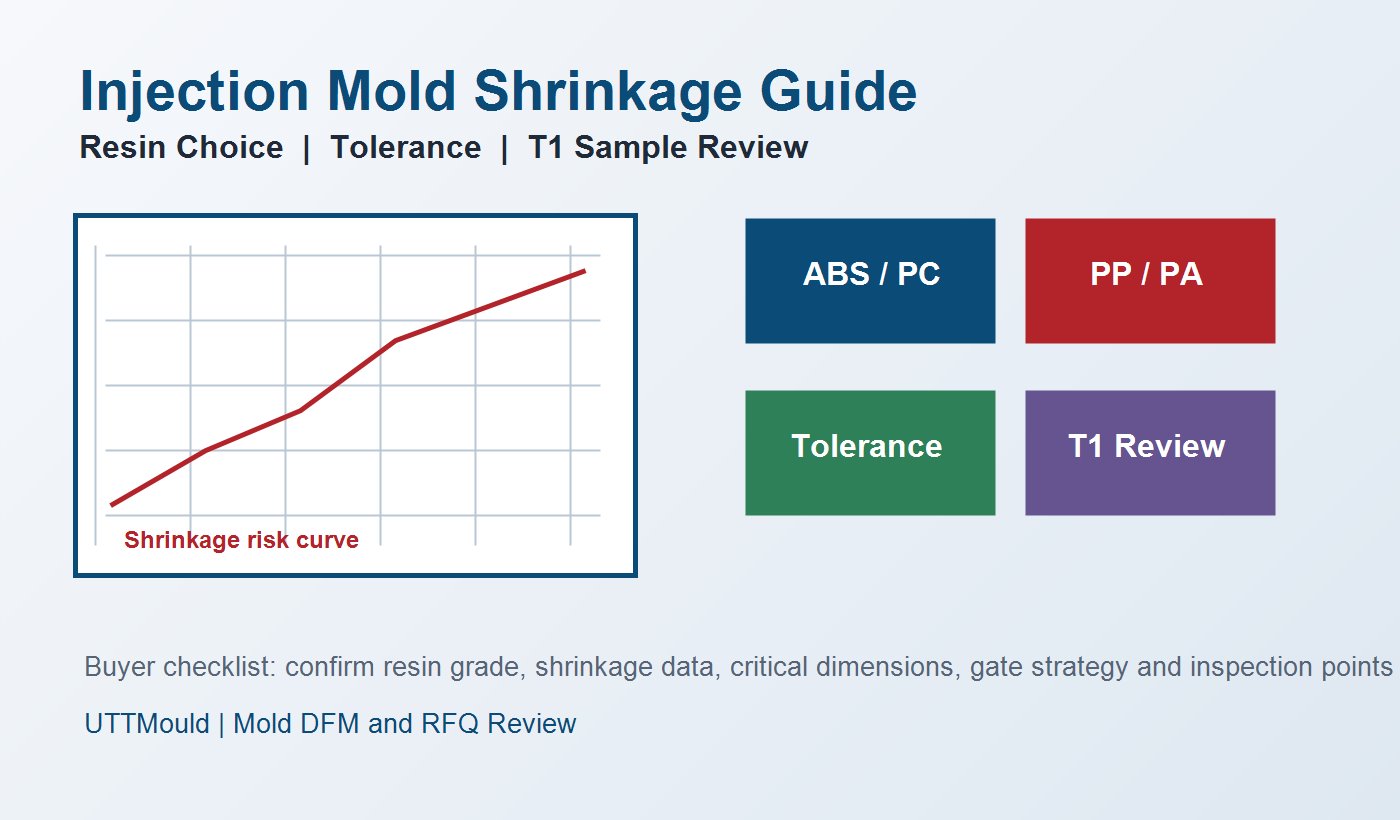
Injection mold shrinkage is one of the most important material factors in plastic part manufacturing. The same part design can behave differently when molded in ABS, PP, PA, PC, POM or glass-filled material. If the resin is not confirmed before tooling, the mold maker must estimate shrinkage and leave more risk for T1 samples.
Every molded plastic part becomes smaller after cooling. The shrinkage rate depends on resin type, filler content, wall thickness, gate location, mold temperature, packing pressure and part geometry. A small difference in shrinkage can create dimensional deviation on critical features.
Different resin families create different DFM questions. Buyers do not need to solve every molding detail before quotation, but they should provide enough material information for a realistic mold review.
| Resin choice | Buyer should confirm |
|---|---|
| ABS / PC / ABS+PC | Surface finish, impact requirement, color, painting or plating needs. |
| PP / PE | Flexible function, living hinge requirement, shrinkage range and warpage tolerance. |
| PA / Nylon | Moisture condition, glass fiber percentage, strength target and dimensional stability. |
| POM | Wear function, precision features, gate location and tolerance control. |
| Glass-filled resin | Fiber direction, cosmetic surface expectation, strength direction and warpage risk. |
When a part has critical dimensions, the buyer should mark them clearly on the drawing. The mold maker can then review whether the requested tolerance is realistic for the resin, part size and mold structure. For some features, tolerance control may require better steel conditions, stable molding parameters, extra inspection or a small design adjustment.
For more detail on dimensional requirements, read: Injection Mold Tolerance Guide Before Tooling.
Before requesting an injection mold quotation, buyers should send practical material information instead of only writing "plastic" or "similar resin". The more complete the RFQ package is, the easier it is to review tooling risk and production feasibility.
For a broader RFQ preparation view, read: Plastic Resin Selection for Injection Mold Projects.
T1 samples are the first real test of material, mold design and processing assumptions. If shrinkage is not controlled, buyers may see short dimensions, poor assembly fit, warpage, sink marks, gate stress or inconsistent measurement results. A documented T1 review helps separate material behavior from tooling issues and molding parameter issues.
For sample approval planning, read: Injection Mold Trial Checklist for T1 Samples.
Autodesk describes mold shrinkage allowance as the cavity scaling used to account for process-induced material shrinkage. Its guidance also explains comparing the simulated final shape with the designed part dimensions and tolerances.
Technical reference: Autodesk: Mold shrinkage allowance
Nominal resin shrinkage is a starting point, not a guarantee of every finished dimension. Review the chosen material, geometry and process conditions, then compare trial measurements with the agreed drawing requirements.
UTTMould supports overseas buyers with injection mold manufacturing, DFM review, resin discussion, mold trial, dimensional inspection and molded plastic part production. When buyers send CAD files, drawings, resin requirements and production targets, our team can review shrinkage risk, gate and cooling concerns, tolerance feasibility and T1 sample approval points before tooling starts.
Send CAD files, resin requirements and target quantity for injection mold DFM and RFQ review.
Shrinkage can affect mold design, steel correction risk, tolerance control, inspection needs and T1 sample adjustment time. Clear resin information helps the supplier quote with fewer assumptions.
No. Tolerance depends on resin behavior, part size, wall thickness, feature location, mold structure and molding stability. Critical dimensions should be reviewed before tooling.
Buyers should send the target function, expected operating environment, appearance needs, strength requirement, compliance needs and possible resin options so the mold maker can review risk.
This guide focuses on shrinkage allowance: how resin data informs cavity sizing and how molded dimensions are checked during T1 review.
Updated September 15, 2026: technical reference and scope clarified.
Follow Us: 


Copyright © 2026 UTTMould All Rights Reserved Sitemap XML Quality Inspection Checklist Injection Mold Guide