Quick answer: Injection mold warpage is usually caused by uneven shrinkage, non-uniform wall thickness, poor rib design, unbalanced cooling, unsuitable gate location or resin behavior. Overseas buyers can reduce deformation risk before tooling by confirming resin grade, critical flatness dimensions, wall thickness targets, assembly fit requirements, appearance expectations and T1 sample inspection standards.
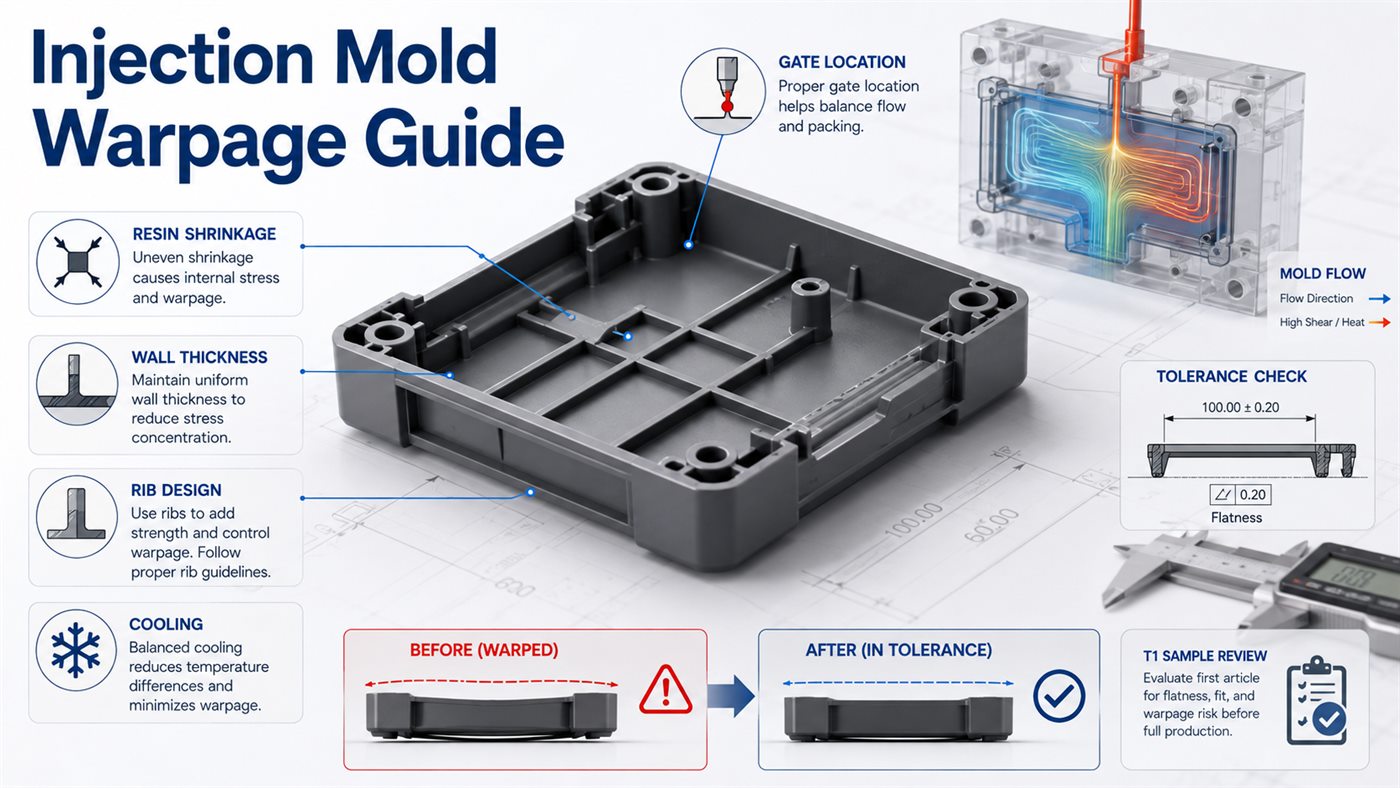
Plastic part deformation can appear as bending, twisting, uneven flatness, poor assembly fit or visible surface distortion. In many injection mold projects, warpage is not only a molding issue. It often starts with part design, resin selection and incomplete DFM review before mold steel is cut.
Once the mold is built, correcting warpage can require steel changes, gate adjustments, process tuning or even part design changes. For overseas buyers, early warpage review helps reduce T1 sample delay, quotation uncertainty and production quality risk.
| Cause | What buyers should confirm |
|---|---|
| Uneven wall thickness | Nominal wall target, thick bosses, ribs, transitions and sink-sensitive areas. |
| Resin shrinkage | Material family, exact grade, filler content and shrinkage data. |
| Poor gate location | Cosmetic surface, weld line risk, flow direction and packing balance. |
| Cooling imbalance | Flatness area, thick sections and mold temperature control expectations. |
| Assembly stress | Snap fits, screws, mating parts, clips and functional flatness requirements. |
Before RFQ and mold design, buyers should send information that helps the mold maker review deformation risk in a practical way.
For material behavior, read: Injection Mold Material Shrinkage Guide. For dimensional control, read: Injection Mold Tolerance Guide Before Tooling.
T1 samples should be checked for flatness, twist, assembly fit, cosmetic deformation and dimensional stability. Buyers should compare the molded samples with the drawing, assembly requirements and inspection plan instead of judging only by appearance.
For sample approval planning, read: Injection Mold Trial Checklist for T1 Samples.
UTTMould supports overseas buyers with injection mold manufacturing, DFM review, mold flow discussion, resin selection review, mold trial, dimensional inspection and plastic injection molding production. When buyers send CAD files, resin requirements and production targets, our team can review wall thickness, gate, cooling, tolerance and T1 approval risks before tooling starts.
Send CAD files, resin requirements and target quantity for injection mold DFM and RFQ review.
Common causes include uneven shrinkage, non-uniform wall thickness, poor rib design, unbalanced cooling, gate location issues, resin behavior and assembly stress.
Some warpage can be improved by molding parameter adjustment, but serious deformation may require mold correction or part design changes. Early DFM review is better.
Buyers should mark flatness requirements, critical dimensions, assembly surfaces, cosmetic faces and inspection methods so the mold maker can review feasibility before tooling.
This guide focuses on shape distortion: flatness, bowing and assembly mismatch associated with wall layout, ribs, cooling, gates and material behavior.
Updated September 15, 2026: guide scope and related reading clarified.
Follow Us: 


Copyright © 2026 UTTMould All Rights Reserved Sitemap XML Quality Inspection Checklist Injection Mold Guide